Two Women on a Mission
News flash: After Amba by Stephanie Shields is the Gold Medal Winner in the 2025 WSA Independent Book Awards for Adult Fiction.
It’s late August 2025.
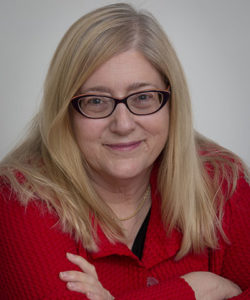
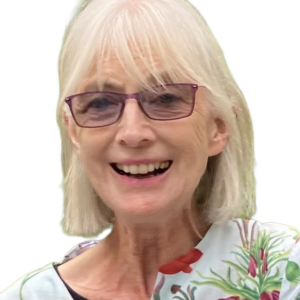
This is us, Stella and me. Two women novelists of a certain age. We’re sharing a view and we’re sharing a vision. Two older women on a mission. Empowerment, creativity and presence. Yes presence, for invisibility is not a special power—it’s a problem for older women.
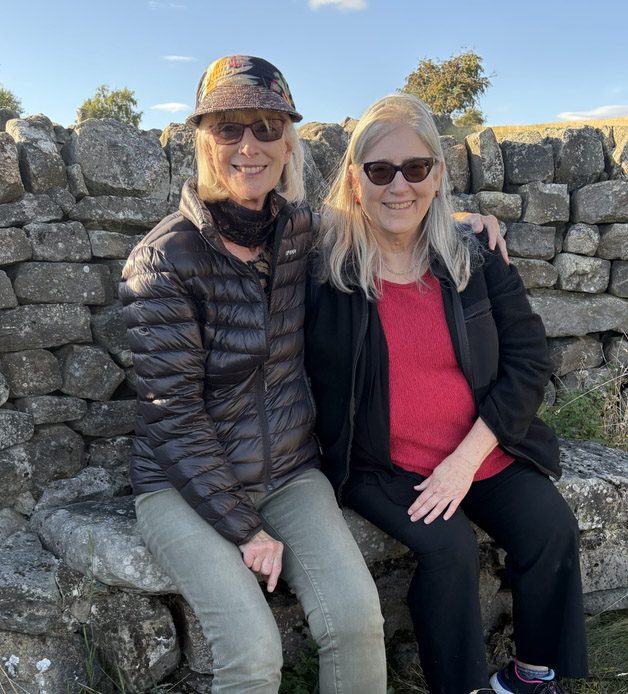
We’re sitting on the stone seat above The Gill. Timble Gill is the place where Satan is said to have supped with seven women from my tiny village, four hundred years ago. Their accuser is Edward Fairfax, a deranged poet of the court of King James 1st. Fairfax is determined to see them hang on the three-legged mare, the local name for the gallows. It’s a triangular construction cunningly designed to hang three at once for efficiency. We’re back in the days when watching women swing was such fun they charged a fee.
Women, especially older women, poor women, ugly women, disabled women, women involved in the natural health service—carers, midwives and herbalists—trouble-making women, women with dementia, lascivious women, women who talked too much and any woman beyond childbearing age would be deemed superfluous and thus, disposable—a burden on the community, and a nuisance on the land because they foraged for wool, wood, plants and other wild food. Women just like you and me.
Yes, Stella and me might have found ourselves in their number bound together on the cart to York Castle Gaol.
This stone seat started its life as a gate post. In ancient times it was holes for poles – the old way to keep your sheep in. The stone was cast aside in World War Two to allow the big machinery in, to plough the land for ‘Dig for Britain.’ This was a daft initiative; boulder clay doesn’t do vegetables. This is sheep country.
The old stone lay grounded on its side until 2015. On August 15th, the seventieth anniversary of VJ Day, we resurrected the stone to create a seat for walkers, and for us. It’s a fine spot to watch the flock.
On this stone seat ten years ago, I saw something poking out of the hole close to my right thigh. A tissue, paper, a card? I confess I am a wee bit squeamish. Cast tissues are not something to tangle with, especially on such a remote hill overlooking the valley. Perhaps someone had been caught short? But something made me fish it out.
It was a business card from a young woman. On one side the nicely printed details of her ‘make do and mend’ business in Hebden Bridge, West Yorkshire: new curtains, new zips, trouser shortening, you name it. On the other side a message scrawled in ink:
‘Lizzie was here – call me.’
I stuffed it in my pocket and went to check the sheep. Bit risky, I mused. All your personal details. What if it had fallen into the hands of a wrong ‘un? A sisterly act—Lizzie was safer with her card in my pocket.
Strange Woman
But something started bubbling in my brain. Every time I rooted in my pocket for my own tissue, the card’s corner stuck into my palm, as a thorn pierces a poppet. Or a cattle prod to move the beast along. Inspiration comes in many guises. And thus began the writing of The Strange Woman.
The Strange Woman recreates the 1622 Yorkshire witch trial, the Trial of the Timble Witches, told from the women’s point of view and a love story set in the same village four hundred years later. It’s about the cruelty of men and the collective power of women, a tale of courage, love, hope and nature. This book has won readers from all over the world and enjoys something of a cult following in Yorkshire. It has been the best-selling book at Wave of Nostalgia bookshop in Haworth for the past four years.
And no spoilers, but yes, the stone seat features.
The past presses on the present in my writing, just as it does in the landscape of the Washburn Valley where I live and farm. It’s an ancient landscape. The past lies so close to the surface, it is impossible to walk the fields and the steep gills and avoid the ghosts. Rock art, stone circles, cairns, ancient ways, stones worn by the sheer footfall of the generations, the folk who passed before. There’s even a healing well on our land. Each feature clamours to tell its own tale.
As a writer of short stories and novels I am drawn to strong women. I draw strong women.
After Amba
For my next novel, After Amba, something different, but not entirely so. Another cast of strong women certainly. These are women fired by the heady days of early twentieth century feminism, women who lived through two world wars, and that period between the wars. These were the women who got the vote in the Flappers’ Election of 1929.
‘Cycling killed the corset!’
‘Beauty is a duty!’
These were the women in the first flush of feminism. Women exploring and enjoying their sexuality.
When fashion and travel writer Amba Atha boards a plane to fly home to England from Stockholm’s Bromma Airport in July 1948, she embarks on the flight of her life. As a ‘New Woman,’ Amba is a trailblazer who pushes boundaries. She has such a powerful hold on life that even after her death, she exerts control of events and the living. Seventy years later, her brother Andrew hires a young research librarian, Frasey Fisher, to bring order to Amba’s archive. Frasey becomes captivated, possibly possessed, by her subject. Frasey is drawn into a love triangle that transcends class, time and death.
After Amba is a tale about women, love and sexuality, and the power of the past over the present.
Yes, I’m looking forward to my next encounter with Stella on the stone seat above Timble Gill.