
When Zebras Meet
Managing Under-Researched Conditions
I’ve written before about the old medical school mantra, “When you hear hoofbeats, look for horses, not zebras.” In other words, consider the common diagnoses first. Sounds reasonable; but keep in mind that the saying originated back when medical school was a white guys’ club. In practice, “Horses, not zebras,” too often translates as, “Focus on conditions that are common to male Caucasians.” Illnesses that primarily affect women (such as migraines, autoimmune disorders and endometriosis) are more likely to be considered zebras, to be misdiagnosed and poorly understood.
It’s not uncommon for a woman to experience more than one of these neglected medical conditions, especially as we age. And just as medications can interact in unpredictable ways, medical conditions can affect each other during treatment. Even working with an enlightened physician can’t make up for the absence of research.
Learning and self-advocacy can help deal with this reality. Let’s start with an example.
Zebra #1:
I was tempted to begin this essay with a survey like this:
Q: What is a seroma? Choose one:
- “My Seroma” was a popular 1950s love song.
- Seroma is a chichi town in New Mexico. Aging hippies flock there to chant and take colon cleanses.
- A seroma is a fairly common post-mastectomy complication. It’s basically a water balloon made of the skin on your chest.
Did you pick C? Bingo.
The first time I heard the word “seroma” was the week after my mastectomy. I went to the doctor thinking the bulge near my incision was a hemorrhage. It was not. My surgeon explained that after mastectomy, most people’s skin adheres to the tissue beneath it, allowing it to heal.
But in some cases clear bodily fluid refills the opening under the skin where breast tissue used to be. That bolus of liquid is vulnerable to infection and may persist for months. Even after fluid is removed by aspiration, the cavity can keep refilling. Some women require a second surgery to bind their skin to the underlying tissue. Yet little is known about why some women develop seromas while others do not.
After a bit of lidocaine, the medical folks extracted a couple hundred cubic centimeters of fluid from my chest. Once I knew what I had, I read every medical journal article about seromas that I could get my hands on (which was not much). Questions remained: Why me? Many women’s seromas come back after treatment; would mine? Who knew?
Which brings us to…
Zebra #2:
As a kid in the 1960s, it was fun to be more flexible than the people around me. I could wiggle the ligaments across my knuckles or pop my arms out of their sockets and pop them back in. I’d never heard of hypermobile Ehlers-Danlos Syndrome (hEDS), a genetic mutation that mostly affects females. Then in 1984, my daughter maneuvered herself in utero to tuck one foot behind her head. She apparently left her foot there as she grew during her last trimester. As a result, she was born with one knee bent backwards. A pediatric knee orthopedist in New York City diagnosed both she and I with hEDS.
Fast forward to 2025. When the medical team drained my seroma, I asked whether hEDS might contribute to my risk.
“No,” answered the physician’s assistant. “EDS affects tendons and ligaments, so it’s not relevant.”
I knew from experience that hEDS can affect health outcomes in ways that medical providers are not equipped to manage. During my first pregnancy in 1980, my twin boys sat front to back in my (very flexible) uterus. My obstetrician insisted I must be carrying one baby, because, he told me, “Nobody carries twins front to back.” New York Hospital had just acquired its first sonogram machine, but the doctor assured me there was no need to order a scan. He reassigned my due dates based on his misdiagnosis and induced my identical twin sons two months early. As a result, one of my boys almost died and the other has a lifelong disability.
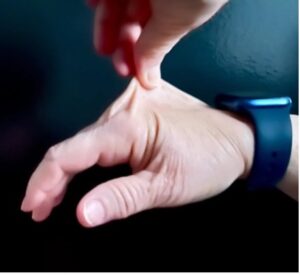
So after the PA told me hEDS was “not relevant,” I went home and read medical journal articles, just to be sure. I learned that the skin of people with hEDS is super stretchy. If you pinch the skin on the back of your hand and can pull up at least 1.5 centimeters, that’s considered hyper extensible skin. Mine stretched more than 2 cm, which means my skin doesn’t resist expansion by fluid. It’s great material for a water balloon (or an expanding seroma).
Life is Not a Controlled Experiment.
Women are typically given a breast binder after surgery, but I was only told the binder might make me “more comfortable,” which it did not, so I didn’t wear it. But when I combined what I’d learned about seromas with what I’d just read about stretchy skin in hEDS, I decided to wear the binder 24/7 to add external compression. Then a physical therapist made me a custom foam insert to wear inside the binder and increase compression even more.
The result? I’ve been lucky: Days after adding the pressure from the foam insert, my seroma stopped expanding and fluid began to reabsorb into my body. In a few weeks my skin healed together and the seroma was nearly gone.
Life is not a controlled experiment. If I hadn’t started consistent 24 hour compression, would my seroma have disappeared anyway? On the other hand, if I had known to compress from the beginning, would that have prevented the seroma from ever forming? I’ll never know.
But for the benefit of other women with breast cancer, it would be a good idea to learn more.
Speaking of Experiments…
If you are reading this and happen to be a breast cancer clinician, consider gathering some information about the meeting of these two zebras. The so-called “rubber glove test” only takes seconds, you don’t need funding for a study, and you don’t even need to know whether patients have an official diagnosis of EDS. Try this:
- Pull up the skin on the backs of the hands of five of your patients who developed clinically significant seromas after mastectomy. What is the average extensibility for this group?
- Now do the same for five of your patients who did not develop seromas post-mastectomy. What is this group’s average extensibility?
If the first group has greater extensibility, consider making the rubber glove test part of your pre-surgery evaluation. Also consider advising patients with extensibility over 1.5 cm to apply consistent external compression in the weeks after breast cancer surgery.
If you are not a medical professional, but you are a woman about to have breast cancer surgery, you can check the stretchiness of your own skin with the rubber glove test. And then, if your skin is stretchy, discuss the importance of consistent external compression with your doctor.
When Zebras Meet: What’s Next?
I’ve written before about individualizing medical treatment for women, especially later in life. No two of us have exactly the same bodies, the same health challenges, or the same ideal solutions.
Learning about our own health needs supports that individual approach. If you’re comfortable reading peer reviewed medical journals, that’s great. Or consult reliable sources intended for lay readers, such as the Harvard Health Letter and the Mayo Clinic collection of articles on various health challenges. There are also societies that provide information about particular conditions (for example, the Ehlers-Danlos Society, whose logo is a zebra). The more you know, the better able you’ll be to discuss your particular health needs with your medical team.
We live in an era of corporate medicine, where standard protocols and short appointments make it essential to advocate for ourselves. This is especially true for those of us with an under researched medical condition. The human body is complex; doctors don’t know everything and neither do we. Forty years after being diagnosed with hEDS I still have more to learn about how it affects my health outcomes—and so does my medical team.
The Bottom Line:
Learning about our health and actively co-managing it with our medical team takes time and effort. The payoff is better health and more time for the important work of doing whatever the hell we want.
2 Responses
Stella, this piece is soooo important. Ironically, I happened on a “Golden Girls” rerun last night in which Maude was exhausted and constantly told nothing was wrong with her. Finally, a doc determined she had chronic fatigue—that was not “all in her head.” Fifty years later. Women suffering the same indignities—and worse.
Very true, Melinda! That’s why it’s so important to educate ourselves and advocate for ourselves as long as we can!